Polarization-sensitive holography
Birefringent materials delay light differently depending on its polarization. In tissue, birefringence comes from ordered structures such as collagen fibres and myelin sheaths, so measuring it reveals organisation that intensity and ordinary phase images miss.
A sample’s full polarization response is described by its Jones matrix. Measuring all four elements usually takes several sequential acquisitions, which are sensitive to phase drift, or a complex single-shot optical layout.
Two shots, full Jones matrix
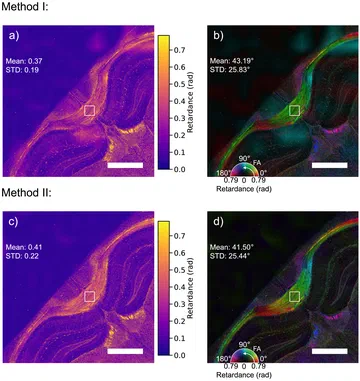
Our dual-shot polarization digital holographic microscope records two off-axis holograms with orthogonal input polarizations, set by a motorized half-wave plate. A polarization-sensitive camera captures four analyser channels in each exposure. A phase bias equalization step aligns the phases of the Jones elements across the two shots, so the full-field Jones matrix can be reconstructed without the drift problems of longer sequences.
We validated the method on birefringent polymer films and applied it to mouse brain sections and human cornea.
Collaboration
This work was part of a TÜBİTAK–NARD bilateral project with colleagues in Moldova (2024–2026) on polarization-sensitive holographic microscopy with structured illumination.
Key publications
Dual-shot polarization digital holographic microscopy with phase bias equalization for full-field Jones matrix imaging
Mohammad M. T. R. Hussein, M. Fatih Toy
Biomedical Optics Express, 17, 2026Journal article
DOIPDFCite
@article{hussein2026dual,
  title={Dual-shot polarization digital holographic microscopy with phase bias equalization for full-field Jones matrix imaging},
  author={Hussein, Mohammad MTR and Toy, M Fatih},
  journal={Biomedical Optics Express},
  volume={17},
  number={4},
  pages={1877--1896},
  year={2026},
  publisher={Optica Publishing Group}
}